eVTOL Market 2026: The Year Air Taxis Go From Promise to Reality
Laxman Kafle

In this article (9)▼
After years of prototypes, test flights, and ambitious projections, 2026 is shaping up to be the year that electric vertical takeoff and landing aircraft transition from engineering programs to commercial transportation. Multiple companies are approaching certification milestones, regulatory frameworks are crystallizing, and the investment landscape reflects growing confidence that air taxis will become reality.
This comprehensive market analysis examines the key drivers, milestones, risks, and opportunities shaping the eVTOL industry in 2026.
The Dubai Launch: eVTOL's Commercial Debut
The most significant near-term milestone is Joby Aviation's planned commercial launch in Dubai during 2026. Joby holds exclusive six-year operating rights in the emirate and completed a landmark 17-minute point-to-point flight to Al Maktoum Airport in November 2025.
Dubai offers ideal conditions for eVTOL's commercial debut:
- Supportive Regulation: The UAE has created a regulatory framework specifically for eVTOL operations
- Established Demand: Dubai's wealth, tourism traffic, and urban sprawl create natural demand for premium air mobility
- Infrastructure Willingness: The Dubai government is actively investing in vertiport infrastructure
- Weather: Consistent flying conditions reduce weather-related service disruptions
- Global Visibility: A successful Dubai launch will capture worldwide attention and build confidence in the technology
If Joby achieves regular commercial operations in Dubai, it will mark the first time paying passengers board an eVTOL air taxi outside of China, where EHang has been conducting limited commercial flights.
FAA eIPP: March 2026 Selections
The FAA's eVTOL Integration Pilot Program (eIPP) is expected to announce selected participants in early-to-mid 2026. This program will authorize pre-commercial eVTOL operations at selected US locations, providing:
- Real-world operational data for regulators and manufacturers
- Public demonstration opportunities that build passenger confidence
- Infrastructure development at pilot sites
- Regulatory precedents that inform broader commercial authorization
Both Joby and Archer are expected applicants. Selection would validate their programs and provide a clear pathway to US commercial operations. The eIPP selections represent one of the most important regulatory catalysts of 2026.
MOSAIC: July 2026 Provisions
The FAA's Modernization of Special Airworthiness Certification (MOSAIC) rule, which took effect in August 2025, includes additional provisions scheduled for July 2026. These provisions will:
- Expand Light Sport Aircraft definitions to include certain powered-lift configurations
- Reduce pilot certification requirements for qualifying aircraft (sport pilot license with ~15 hours minimum training)
- Enable new business models for personal eVTOL ownership and operation
- Create certification pathways for smaller, simpler eVTOL designs
Companies like AIR, which became the first eVTOL to receive FAA certification under initial MOSAIC rules, and LIFT Aircraft, pursuing FAA Type Certification for its Hexa-C, stand to benefit significantly from the expanded July provisions.
MOSAIC represents a parallel path to the traditional Part 21 type certification pursued by larger air taxi programs. It could enable a personal eVTOL market that develops alongside commercial air taxi networks. Learn more about these regulatory developments.
Market Forecasts: The Numbers
Industry analysts have revised their eVTOL market projections upward as the technology approaches commercial viability:
Vehicle Deployments: - 2030: ~1,500 eVTOL vehicles in commercial service globally - 2035: ~4,000 vehicles across 50+ cities - 2040: ~7,500 vehicles with established route networks - 2050: ~145,000 vehicles in a mature global market
Market Value: - 2030: $5-8 billion annual market - 2035: $20-30 billion - 2040: $50-70 billion - 2050: $150+ billion
Job Creation: - Pilots: 15,000-25,000 new pilot positions by 2035 (see eVTOL pilot jobs) - Manufacturing: 50,000+ manufacturing jobs - Infrastructure: 30,000+ vertiport construction and operations jobs - Support Services: 100,000+ in maintenance, training, software, and logistics
These projections assume successful certification and scaling by multiple manufacturers. The realized market could be significantly larger or smaller depending on regulatory outcomes, technology performance, and public acceptance.
Investment Landscape
The eVTOL investment landscape has matured significantly. Key publicly traded companies and their recent valuations:
Joby Aviation (JOBY): Trading around $10.10 per share. Market cap of approximately $7.5B. The most advanced Western certification program, with Dubai commercial launch imminent. Toyota's $900M investment and 200 embedded engineers provide manufacturing credibility. Track JOBY stock.
Archer Aviation (ACHR): Trading around $7.19 per share. Market cap of approximately $4.5B. LA 2028 Olympics and Serbia EXPO 2027 partnerships provide demand visibility. Abu Dhabi Q3 2026 launch approaching. $2B+ liquidity and $6B+ order backlog. Monitor ACHR performance.
BETA Technologies (BETS): IPO in November 2025 brought the cargo-first eVTOL developer to public markets. ALIA aircraft with 250+ mile range and UPS logistics partnership differentiate the business model.
Eve Air Mobility (EVEX): Embraer-backed developer with 2,800+ aircraft orders from 28 customers. First full-scale prototype flight completed in late 2025. Vector ATM software provides additional revenue stream.
EHang (EH): World's first certified and commercially operating eVTOL. Benefiting from China's $1.7B Shenzhen investment and rapid infrastructure buildout.
Private companies attracting significant capital include Wisk Aero (Boeing-backed autonomous eVTOL), AutoFlight (5-ton Matrix aircraft), and numerous infrastructure and software startups.
Key Risks
Despite the positive momentum, several risks could slow or reshape the industry's development:
Certification Delays: The FAA's certification process remains the single biggest variable. While Congress has introduced legislation to accelerate timelines, regulatory processes are inherently unpredictable. Any safety incident during testing could trigger additional scrutiny.
Battery Technology: Current lithium-ion batteries limit range and payload. While sufficient for initial urban routes, battery energy density must continue improving for the market to reach its full potential. Learn more about eVTOL battery technology.
Public Acceptance: Air taxis flying over populated areas will face noise concerns, privacy questions, and general apprehension about new technology. Building public trust will require a perfect safety record in early operations.
Infrastructure Buildout: Vertiport networks are essential for commercial operations but expensive and complex to develop. Zoning, permitting, and construction timelines could constrain market growth.
Economic Conditions: eVTOL companies require significant ongoing capital. A severe economic downturn could restrict funding access and delay programs.
Competition from Alternatives: Autonomous ground vehicles, improved public transit, and high-speed rail could reduce the addressable market for air taxis in some corridors. See how eVTOL compares to other modes.
China vs. The West
The US-China dynamic is the defining competitive storyline of the eVTOL industry. China's advantages — centralized regulatory authority, massive government investment, manufacturing infrastructure, and a huge domestic market — have produced the world's only certified and commercially operating eVTOL aircraft.
The US counters with the world's most advanced aircraft programs (Joby, Archer), the deepest capital markets, the strongest aerospace talent base, and a regulatory framework (FAA certification) that carries global credibility. Recent Congressional action to accelerate FAA timelines reflects growing awareness that regulatory speed is a competitive weapon.
The likely outcome is a bifurcated market: Chinese companies dominating the Asia-Pacific market while Western companies lead in North America, Europe, and the Middle East. Cross-market competition will intensify as companies seek EASA, FAA, and CAAC certification for each other's jurisdictions.
What to Watch in 2026
The key milestones that will shape the eVTOL industry this year:
- Q1 2026: Joby Q4 earnings (Feb 25), Archer Q4 earnings (Mar 2), eIPP selections
- Q2 2026: Abu Dhabi commercial launch preparations, MOSAIC expanded provisions preparation
- Q3 2026: Potential Abu Dhabi commercial launch (Archer), Dubai operations ramp (Joby)
- Q4 2026: Year-end assessment of commercial operations, 2027 production planning
How to Get Involved
The eVTOL revolution is no longer a distant promise — it is unfolding in real time. Here's how you can participate:
- Join our waitlist to be among the first to book air taxi flights
- Explore companies leading the eVTOL revolution
- Track eVTOL stocks for investment opportunities
- Understand regulations shaping the industry
- Learn about pricing for future air taxi services
- Discover when air taxis will be available in your city
2026 is the year that air taxis go from promise to reality. The question is not whether it will happen — but how fast.
Sources: Information sourced from official company announcements, FAA publications, SEC filings, and verified industry reports. For corrections, contact us.
Written by
Laxman Kafle
Founder of eVTOL.Travel — building the independent global directory and verified pre-reservation platform for the urban air mobility era. Tracking every operator, vertiport, and city launch toward 2026.
Continue reading

eVTOL Market Forecast: $1.4B in 2026 to $8B by 2033
The global eVTOL market is projected to grow from $1.4 billion in 2026 to $8 billion by 2033, representing a 28.5% CAGR. Piloted operations dominate with 40%+ revenue share, while autonomous operations are the fastest-growing segment at 30.5% CAGR. North America leads with 35% market share.

BETA Technologies: From Vermont Startup to $7.4 Billion Public Company
BETA Technologies went public in November 2025 at a $7.4 billion valuation, raising $1 billion in the largest eVTOL IPO ever. With a $3.5 billion order backlog from Amazon, UPS, and others, BETA is proving that institutional investors believe in electric aviation.
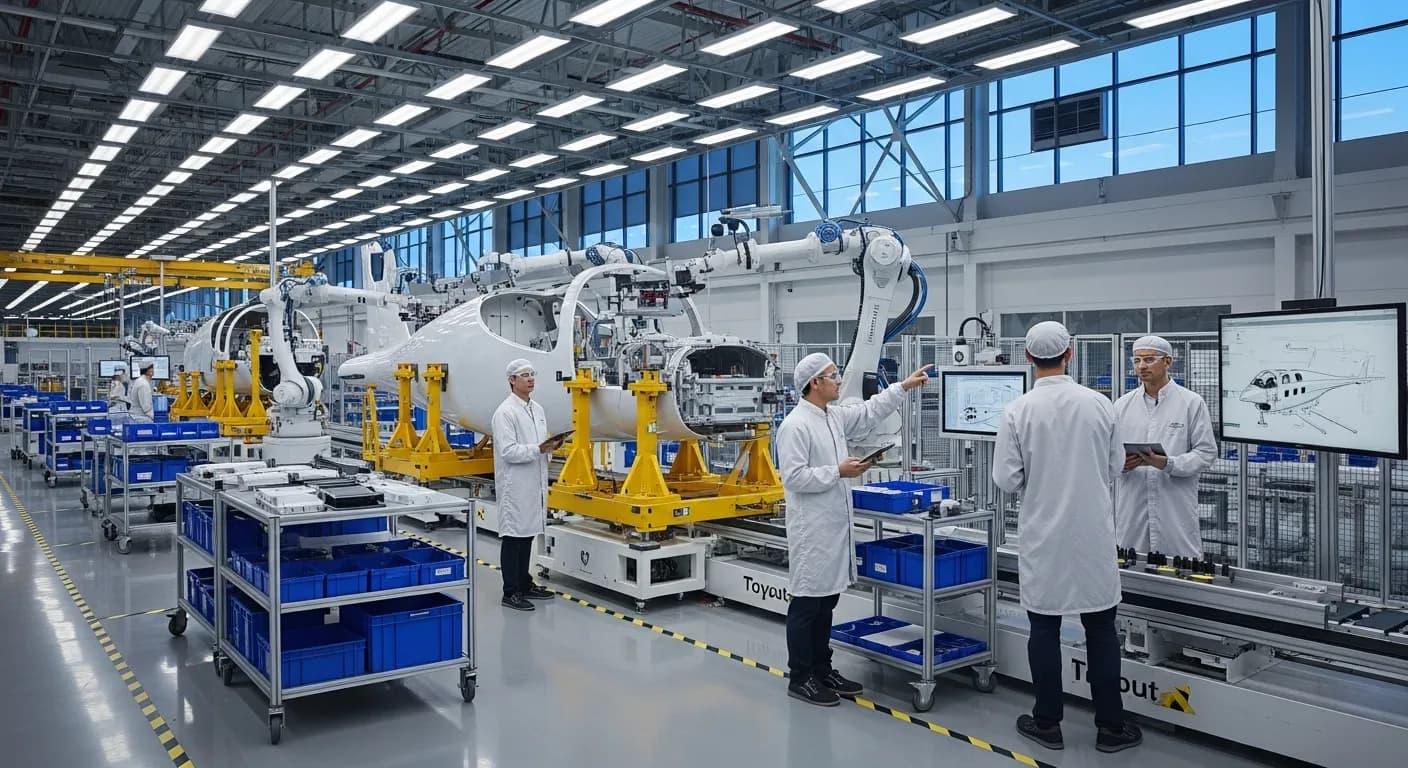
Toyota Embeds 200 Engineers at Joby Aviation: What It Means for Air Taxi Manufacturing
Toyota, Joby's largest shareholder with ~$1 billion total committed, has deployed nearly 200 engineers to bring the Toyota Production System to eVTOL manufacturing. With the Marina CA pilot line doubled to ~435,500 sq ft and targeting 4 aircraft/month by 2027, Joby is scaling production at automotive scale.
Ready to explore the future of air travel?
Discover how eVTOL technology is revolutionizing urban mobility and plan your own aerial journey.