The FAA Is Rewriting the Rules for Vertiports: What the Draft Standard Means and How to Comment by January 11
eVTOL.Travel Editorial
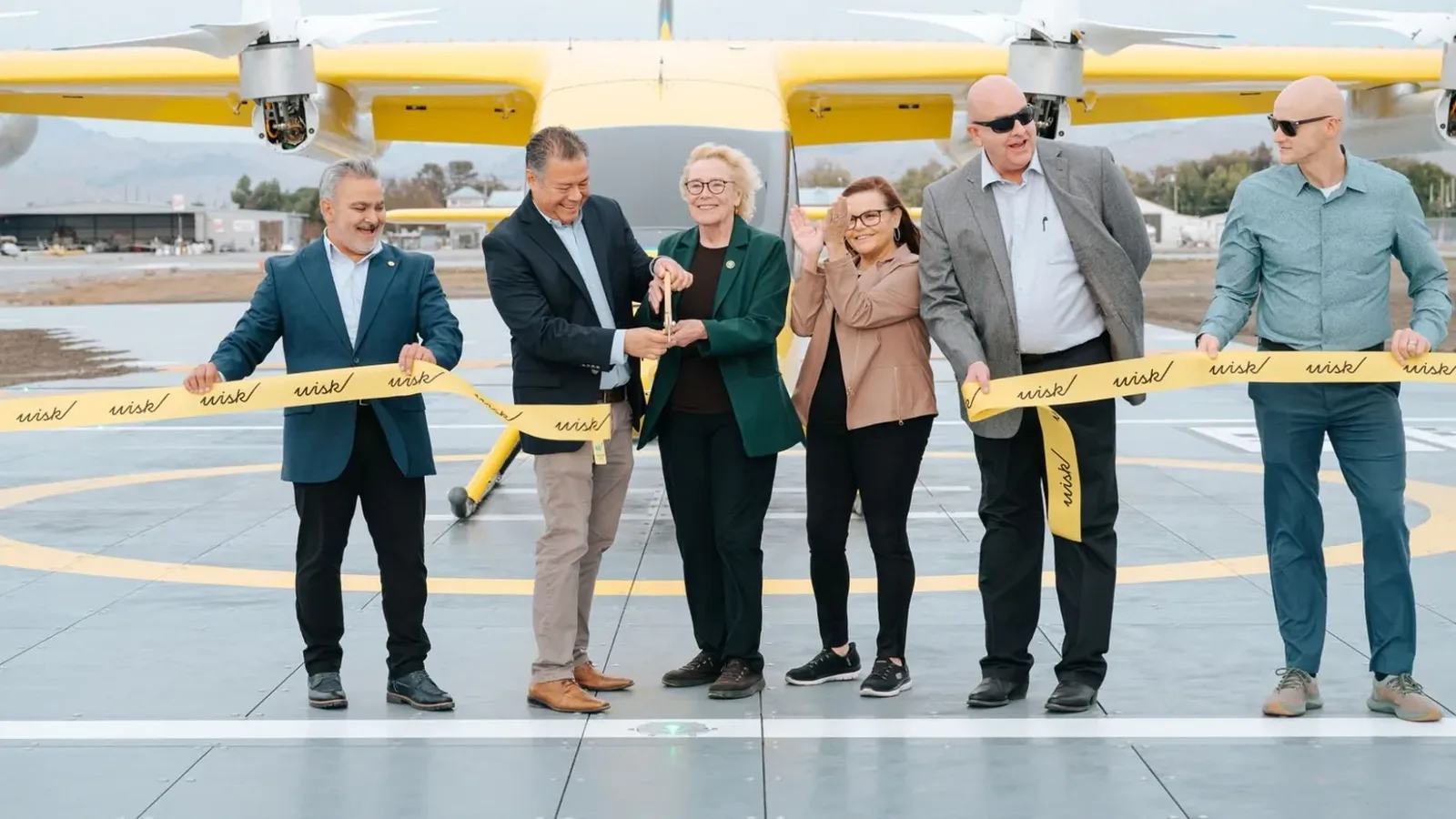
The ribbon cutting at Wisk's new vertiport at Hollister Municipal Airport, California, on October 29, 2026. Image: Wisk.
If you own land, a rooftop, a heliport or an airport site and are thinking about air taxis, this is the document that will decide what you can build. On October 22, 2026, the FAA posted draft Advisory Circular 150/5390-4, its proposed design standard for vertical flight infrastructure. It brings heliport and vertiport guidance together in a single, performance-based document.
The draft is open for public comment until January 11, 2027. The FAA expects to publish the final standard in summer 2027, in time for the first US air taxi services.
The draft at a glance
| Document | Draft AC 150/5390-4, vertical flight aircraft infrastructure design |
| Published | October 22, 2026 |
| Comment deadline | January 11, 2027 |
| Final standard expected | Summer 2027 |
| Replaces | Engineering Brief 105A, the FAA's interim vertiport guidance |
| Approach | Performance-based, covering heliports and vertiports together |
| Touchdown area | The aircraft's rotor diameter plus 10 ft (3 m) |
| Approach surface for powered-lift aircraft | 15:1 or shallower |
| Aircraft limits | The limits in the interim guidance are dropped |
What actually changes
Sizing follows the aircraft, not a fixed template. Under the draft, the touchdown area is the rotor diameter of the aircraft you plan to host plus 10 ft. A site built for a compact two-seat aircraft and one built for a larger five-seat air taxi will not need the same pad.
The interim limits go away. The current guidance, Engineering Brief 105A, was written around a narrow set of assumed aircraft. The draft removes those limits, which opens the standard to the range of designs now in flight testing.
Approach paths matter as much as the pad. The draft sets a 15:1 or shallower approach surface for powered-lift aircraft. In practice, the clear airspace leading to and from the pad, free of buildings, trees, masts and wires, is often what makes or breaks a site.
One document for both. Existing heliports and new vertiports will be covered by the same standard, which should make it easier to work out what an existing helipad needs before it can host eVTOLs.
The first sites are already being built to it
On October 29, 2026, Wisk opened a 100 ft by 100 ft vertiport at Hollister Municipal Airport in California, described as one of the first public, on-airport vertiports in the US able to support both piloted and autonomous aircraft. Wisk uses it to test approach, departure and precision landing procedures.
The FAA and NASA are also using a new vertipad at Orlando International Airport to work out air taxi procedures at a major airport.
What site owners should do now
- Read the draft against your site. Check your pad size against the aircraft you expect to host, and check your approach paths.
- Comment before January 11, 2027. If a requirement would rule out your site, this is the window to say so.
- Do not build to the interim guidance alone. Anything designed today should be checked against the draft, because the interim brief will be cancelled once the new standard is final.
- Plan for what the summary does not settle. Charging, fire safety and rotor downwash also shape a real site. Read the full draft for those sections before you commit money.
If you have a site you want operators to find, you can list a vertiport site with us. For why the US airspace side also needs work, read is air traffic control ready for air taxis?
Get ahead of the first flights
We track every eVTOL launch and every personal eVTOL you can order, and we tell you honestly what can be booked or bought today. Read our guide to buying a personal eVTOL, compare aircraft, or contact us.
We are not the operator. We are the team that gets you there.
Sources: FAA: draft AC 150/5390-4 (PDF) · DroneXL: Wisk opens its Hollister vertiport as the FAA rewrites pad rules, Oct 30, 2026 · Avi-Go: FAA advances AAM integration, Nov 20, 2026 · AIN: Wisk opens vertiport for autonomous eVTOL testing, Nov 3, 2026
Get the eVTOL.Travel brief
Where you can actually fly an eVTOL, aircraft you can buy, and the news that matters. About one email a week.
No spam. Unsubscribe with one click.
Sources: Information sourced from official company announcements, FAA publications, SEC filings, and verified industry reports. For corrections, contact us.
Written by
eVTOL.Travel Editorial
Contributor at eVTOL.Travel — covering electric vertical takeoff and landing aircraft, vertiports, and the launch of urban air mobility worldwide.
Continue reading

FAA Part 194 Explained: The New US Powered-Lift Rule That Lets eVTOL Pilots Train and Fly
Corrected historical article: October 2026 update: older launch predictions and completion percentages below are historical, not current availability. Dubai is not live and targets end-2026; Abu Dhabi is not live and targets late 2026–early 2027. Joby's September report describes fifth-stage FAA work; Archer's May report describes Phase 3 closed and Phase 4 testing, not issued type certificates. eIPP covers 8 projects across 26 states, with the first operation on 10 July 2026; demonstrations are not public ticketed service. The powered-lift final rule dates to October 2024. EHang's March results announced March 2026 sightseeing launches in Guangzhou and Hefei, not commercial operations since 2024.
A Faulty Router Grounded US Flights for Five Hours. Is Air Traffic Control Ready for Air Taxis?
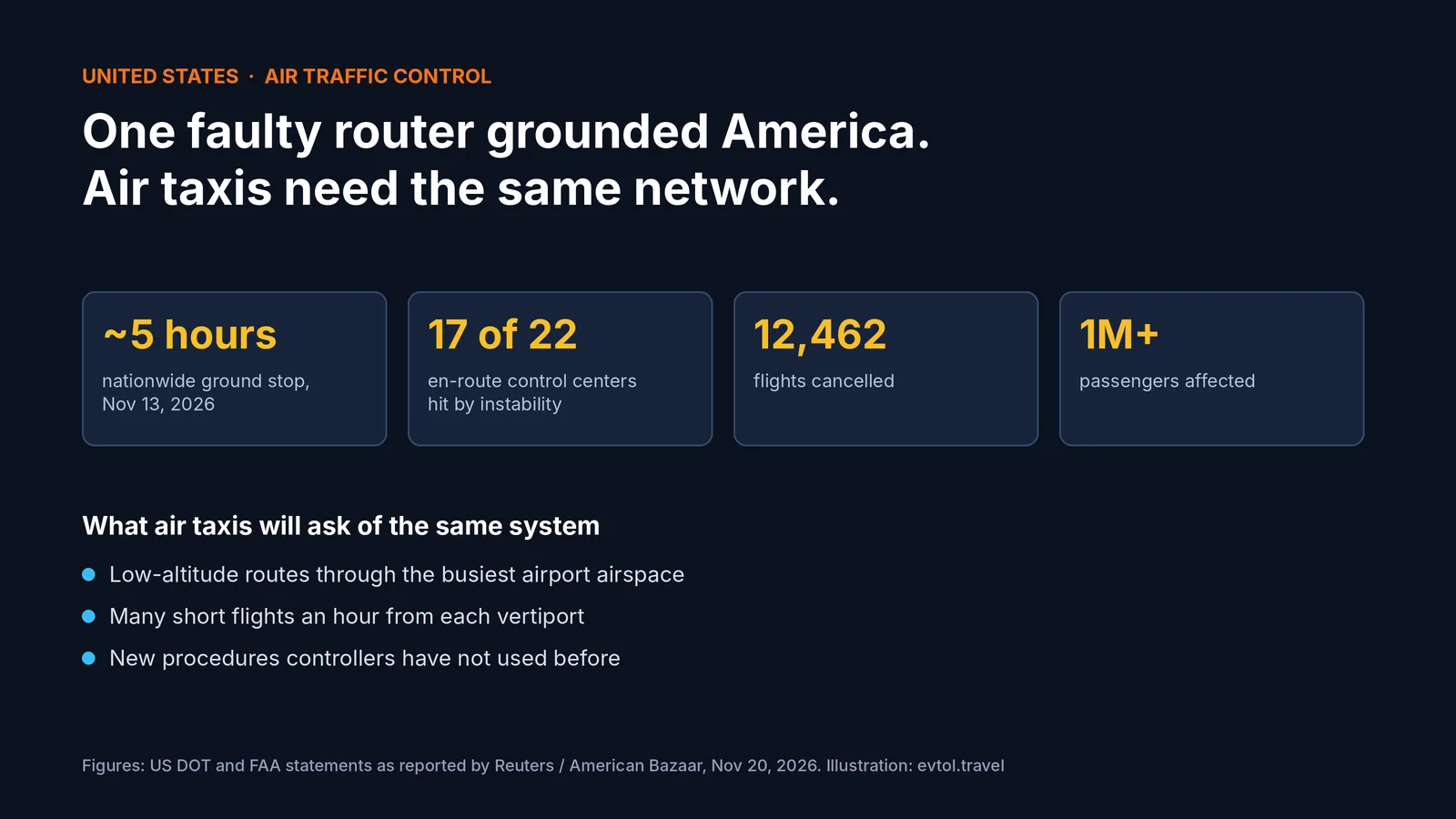
On November 13, 2026, one misbehaving router forced the FAA to halt flights across the United States for nearly five hours. Air taxis planned for 2027 will depend on the same air traffic control network. Here is what happened, what United's CEO has said about air taxis near airports, and what it means for launch dates.
Joby and Archer Push First US Air Taxi Passenger Flights to 2027: What Changed
After their third-quarter results, both Joby Aviation and Archer Aviation now point to 2027 for their first US passenger flights. Here is what each company said, what still has to happen, and where you can fly an eVTOL before then.
Ready to explore the future of air travel?
Discover how eVTOL technology is revolutionizing urban mobility and plan your own aerial journey.