Lesson 1 · 12 min read · Free lesson
What an eVTOL is (and what it is not)
An eVTOL is an aircraft that takes off and lands vertically and uses electric motors to turn several propellers. It is not a helicopter, not a big drone and not a flying car, although it borrows from all three. This lesson covers the three main designs and why so many companies are building them.
Last fact-checked 23 November 2026 by eVTOL.Travel.
The short answer
eVTOL stands for electric Vertical Take-Off and Landing. An eVTOL rises straight up like a helicopter, flies to its destination, and comes straight down onto a small pad. Instead of one big engine and rotor, it uses several electric motors, each turning its own propeller. This idea is called distributed electric propulsion.
Most eVTOLs being built today are meant to carry 1 to 6 people on short trips of roughly 10 to 100 miles: airport to city centre, across a bay, or between nearby towns.
Why not just use a helicopter?
Helicopters already take off vertically, so why build something new? The makers give four reasons:
- Noise. Many small propellers spinning slower can be much quieter than one large rotor. This is what would let aircraft land in cities more often.
- Running cost. Electric motors have few moving parts and electricity is cheaper than jet fuel per trip, so the cost per seat could fall over time.
- Safety through redundancy. If one motor of eight stops, the others can keep the aircraft flying. A helicopter depends on one main rotor system.
- No local emissions. The aircraft burns no fuel in flight.
These are goals, not yet proven at scale. Lessons 3 to 6 look at how close the industry is.
The three main designs
1. Multirotor (wingless)
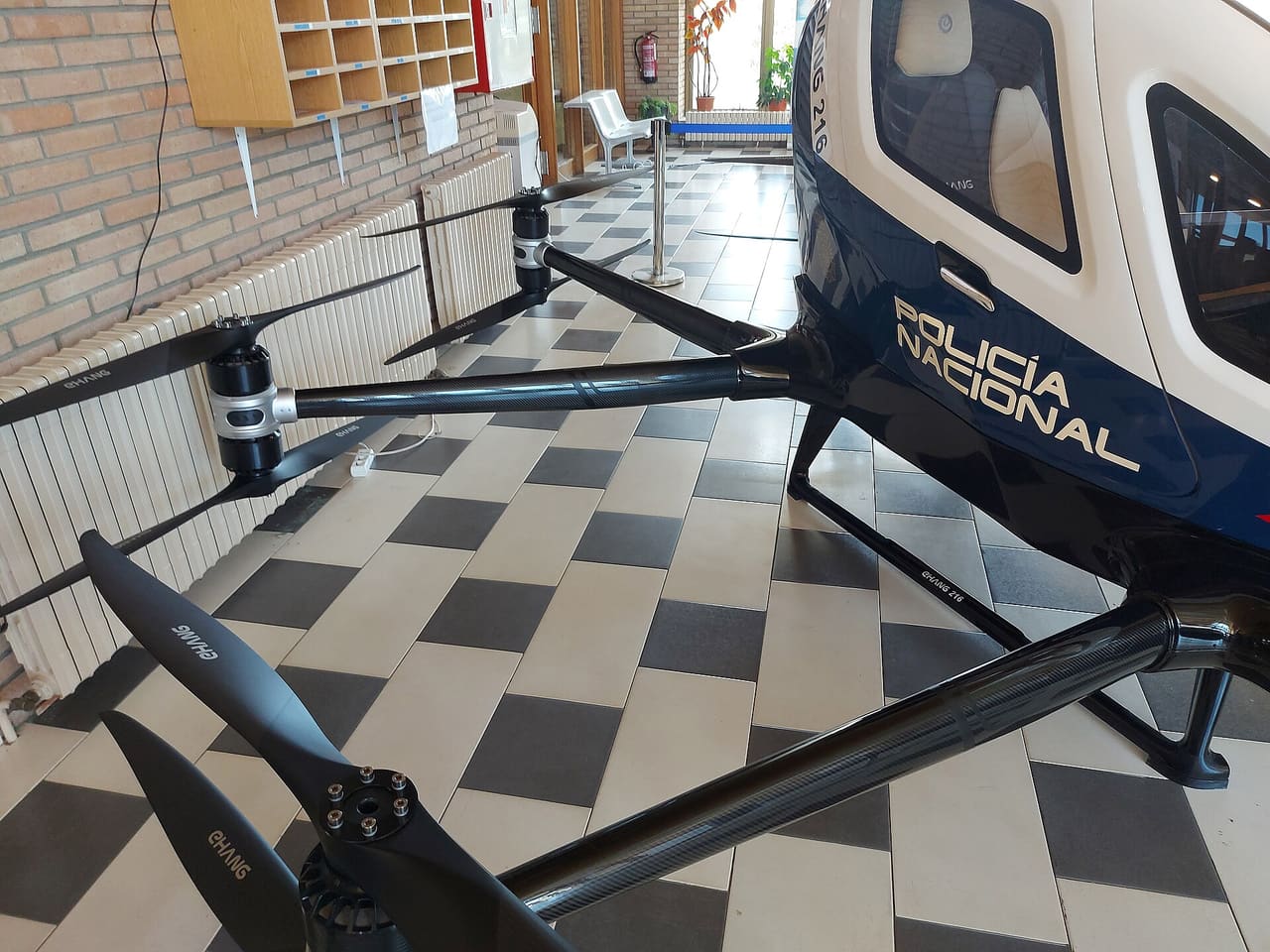
Like a scaled-up drone: many fixed propellers pointing upward, no wing. Simple and very stable in hover, but inefficient in forward flight, so range and speed are short. Example: the two-seat EHang EH216-S from China, with 16 propellers, which flies pilotless sightseeing trips of a few kilometres.
2. Lift + cruise
One set of propellers points up for take-off and landing, and a separate pusher propeller drives the aircraft forward while a wing carries the weight. Simpler than tilting parts, but the lift propellers are dead weight in cruise. Examples: Wisk Gen 6 and Eve's eVTOL.
3. Vectored thrust (tilt-rotor or tilt-propeller)
Some or all propellers tilt: upward to hover, forward to cruise on the wing. This gives the best speed and range but is the hardest to design and certify. Examples: Joby S4 (all six propellers tilt) and Archer Midnight (six tilt, six fixed for lift).
What an eVTOL is not
- Not a drone in the legal sense. Drones carry no people. Passenger eVTOLs are certified as aircraft, to standards close to airliners.
- Not a flying car. A few designs can also drive on roads, but almost all eVTOLs cannot.
- Not always pilotless. In the US and Europe, the first air taxis will have a pilot on board. China's EH216-S is the main pilotless exception.
Who builds them?
More than a hundred companies have announced eVTOL designs, but only a handful are close to carrying paying passengers. In the US: Joby Aviation, Archer Aviation, Beta Technologies and Wisk (owned by Boeing). In Brazil: Eve (Embraer). In China: EHang, AutoFlight and others. In Japan: SkyDrive. Our eVTOL aircraft guide compares the main models.
Key words for the rest of the course
| Term | Meaning |
|---|---|
| eVTOL | Electric vertical take-off and landing aircraft |
| Air taxi | A passenger flight service using eVTOLs, often called Urban Air Mobility (UAM) or Advanced Air Mobility (AAM) |
| Vertiport | A small airport for eVTOLs: pads, chargers and a passenger lounge |
| Powered-lift | The FAA's aircraft category for winged eVTOLs that lift off on propellers and cruise on a wing |
| Type certificate | A regulator's approval that an aircraft design is safe (lesson 4) |
Key takeaways
- eVTOL = electric vertical take-off and landing, using several electric motors and propellers.
- The three main designs are multirotor, lift + cruise and vectored thrust.
- Multirotors are simplest but shortest-range; tilt designs fly fastest and farthest.
- Passenger eVTOLs are certified aircraft, not drones, and most will have a pilot at first.
Check your understanding
3 questions. Get them all right to complete the lesson. You can try again as often as you like.
Save your progress
Enter your email and we will send you a sign-in link. No password, no spam.
Sources
An educational knowledge course by eVTOL Mobility, Inc. (trading as eVTOL.Travel). It is not flight training, does not count toward any pilot certificate or rating, and is not approved by the FAA, EASA or any aviation authority. You receive a certificate of completion, not a qualification. Course terms and refunds.