Are eVTOLs Really Green? An Honest Look at Air Taxi Sustainability
Laxman Kafle

In this article (5)▼
You will hear us — and every other eVTOL company — say "zero emissions." And technically, it is true: electric vertical takeoff and landing aircraft produce no exhaust, burn no jet fuel, and emit no CO2 during flight.
But that is not the whole story.
At eVTOL.Travel, we believe informed passengers make better choices. So here is the honest, data-driven picture of eVTOL sustainability — the good, the complicated, and the challenges the industry still needs to solve.
The Good: Zero Direct Emissions in Flight
Let us start with what is genuinely impressive about eVTOL aircraft:
- No exhaust or tailpipe emissions — unlike helicopters, jets, or cars, eVTOLs produce zero CO2, NOx, or particulate matter during flight
- 85 to 95 percent quieter than helicopters — noise pollution is an environmental factor too, and eVTOLs are dramatically quieter than the helicopters they replace
- Can run on 100 percent renewable energy — when charged from solar, wind, or hydro, the entire energy chain is clean
The numbers are compelling. Per passenger-kilometer, the emissions comparison looks like this:
| Mode | CO2 per passenger-km |
|---|---|
| eVTOL (renewable grid) | ~0g |
| eVTOL (average US grid) | ~15g |
| Electric car (1 passenger) | ~50g |
| Gasoline car (1 passenger) | ~120g |
| Helicopter | ~300g |
Even on a grid powered partly by fossil fuels, eVTOLs produce a fraction of the emissions of the transportation modes they replace. Try our interactive carbon calculator to compare emissions for your specific route.
The Complicated: Grid Dependency
Here is where "zero emissions" gets nuanced. An eVTOL itself produces no emissions — but the electricity that charges its batteries might.
The environmental footprint of an eVTOL flight depends entirely on where the electricity comes from:
Dubai and the UAE — The grid runs on roughly 95 percent natural gas. eVTOLs charged in Dubai are still significantly cleaner than cars (about 30g CO2/km vs 120g for a car), but they are not truly zero-emission. The UAE's push toward solar (they are building some of the world's largest solar farms) will steadily improve this.
Norway and Iceland — With near-100 percent renewable grids (hydroelectric and geothermal), eVTOLs here would be genuinely zero-emission from source to sky.
United States (average) — The US grid is roughly 40 percent clean energy (nuclear, renewables) and 60 percent fossil fuels. An eVTOL on the average US grid produces about 15g CO2 per passenger-kilometer — still 8 times cleaner than a gasoline car.
The critical point: even on the dirtiest coal-heavy grids, eVTOLs produce less CO2 per passenger-mile than single-occupancy cars. The efficiency of electric motors (90 percent+) versus internal combustion engines (20 to 30 percent) creates an inherent advantage.
And the grid is getting cleaner every year. The IEA projects that global renewable electricity capacity will increase by 75 percent between 2023 and 2028. Every eVTOL flying today will automatically become cleaner as the grid decarbonizes — no hardware changes needed.
The Challenge: Lithium and Battery Lifecycle
This is the part most eVTOL marketing ignores. We will not.
Lithium Mining
eVTOL batteries require lithium, cobalt, nickel, and other minerals. The extraction of these materials carries real environmental costs:
- Water usage: Lithium extraction in Chile's Atacama Desert and Argentina's salt flats consumes significant water resources in already arid regions — roughly 500,000 gallons per metric ton of lithium
- Cobalt supply chain: A significant portion of global cobalt comes from the Democratic Republic of Congo, where mining practices have raised serious human rights and environmental concerns
- Land disruption: Open-pit mining for nickel and lithium alters ecosystems and can contaminate local water sources
These are legitimate concerns. The industry is not ignoring them.
What the Industry Is Doing
- LFP batteries (lithium iron phosphate): These eliminate cobalt entirely and are becoming viable for eVTOL applications. CATL and BYD are leading this shift
- Solid-state batteries: Expected to reach commercial viability by 2028 to 2030, these use less raw material, charge faster, and last longer. Toyota, QuantumScape, and Solid Power are frontrunners
- Recycling infrastructure: Companies like Redwood Materials (founded by Tesla's former CTO) and Li-Cycle are building industrial-scale battery recycling facilities. Redwood Materials can already recover 95 percent+ of lithium, cobalt, and nickel from spent batteries
- Responsible sourcing: Major battery manufacturers are increasingly requiring certified, traceable supply chains
For a deeper look at where battery technology is heading, read our full battery technology analysis.
Battery Degradation
eVTOL batteries are expected to last 1,000 to 2,000 charge cycles before needing replacement. For a commercial air taxi completing 20 to 30 flights per day, that means batteries may need replacing every 1 to 2 years.
This is a real operational cost and environmental consideration. However: - Degraded aviation batteries can get a second life in stationary energy storage (grid batteries, building backup power) - Battery recycling technology is advancing rapidly - Battery energy density is improving 5 to 8 percent annually, meaning each generation requires less raw material for the same performance
The Bigger Picture: Mode Shift Matters More Than Emissions Per Mile
Here is perhaps the most important sustainability argument for eVTOLs — and it is not about the aircraft themselves.
What trips do eVTOLs replace? That is what determines their net environmental impact.
When eVTOLs Are a Clear Environmental Win
- Replacing single-occupancy car trips of 20 to 50 miles: This is the sweet spot. A solo driver stuck in traffic for 90 minutes produces far more emissions (and road wear, and congestion) than a 4-passenger eVTOL covering the same distance in 15 minutes
- Airport transfers: The LAX-to-downtown or JFK-to-Manhattan corridor — where thousands of solo car and rideshare trips happen daily — is where eVTOLs can eliminate the most emissions
- Replacing helicopter flights: eVTOLs are 10 to 20 times cleaner than helicopters. Every helicopter flight replaced by an eVTOL is a massive environmental win
When the Equation Gets Complicated
- Replacing efficient public transit: If someone switches from a subway to an eVTOL, the per-passenger emissions likely increase. eVTOLs should complement public transit, not replace it
- Induced demand: If eVTOLs make certain trips so convenient that people take them when they would have otherwise stayed home or video-called, the net effect could be negative
The honest answer: eVTOLs are not a universal environmental solution. They are a dramatically cleaner alternative to cars, rideshares, and helicopters for medium-distance trips — which happen to be the trips that produce the most emissions per passenger. Compare the full picture for your commute with our eVTOL vs rideshare comparison.
Our Position at eVTOL.Travel
We are an operator-neutral booking platform. We do not manufacture aircraft or operate flights. Our job is to connect passengers with the best air taxi options for their routes.
We are also transparency-first. We believe:
- Honest information builds trust — and trust is what converts curious visitors into confident passengers
- The data favors eVTOLs — even with the caveats above, electric air taxis are dramatically cleaner than the cars and helicopters they replace
- The trajectory is positive — cleaner grids, better batteries, and recycling infrastructure are all improving rapidly
- Informed passengers make better choices — and that is good for the industry long-term
We will continue to publish honest analysis — even when it complicates the marketing narrative.
What You Can Do
- Calculate your impact: Use our carbon calculator to see the real emissions comparison for your specific route
- Choose green routes: When eVTOL service launches, prefer operators who source renewable energy for charging
- Pre-reserve your seat: Join the waitlist to show demand for sustainable urban air mobility in your city
- Stay informed: The sustainability picture is evolving rapidly — follow our blog for updates
The air taxi revolution is coming. It is not perfectly green — nothing is. But it is a genuine step forward for urban transportation sustainability, and the technology is getting cleaner every year.
Pre-reserve your air taxi seat for free — help build the future of sustainable urban mobility.
Sources: Information sourced from official company announcements, FAA publications, SEC filings, and verified industry reports. For corrections, contact us.
Written by
Laxman Kafle
Founder of eVTOL.Travel — building the independent global directory and verified pre-reservation platform for the urban air mobility era. Tracking every operator, vertiport, and city launch toward 2026.
Continue reading
State of eVTOL — Q3 2026 Report: Joby Earns First US Type Certificate, 19,600+ Demand Signups, 123 Vertiports
The second quarterly State of eVTOL report is live. Three headline findings: Joby received the first US eVTOL type certificate, FAA issued the first Part 135 powered-lift air carrier certificate, and verified route-interest signups grew 58% QoQ to 19,600+ across 64 cities. Free to cite, free to download.
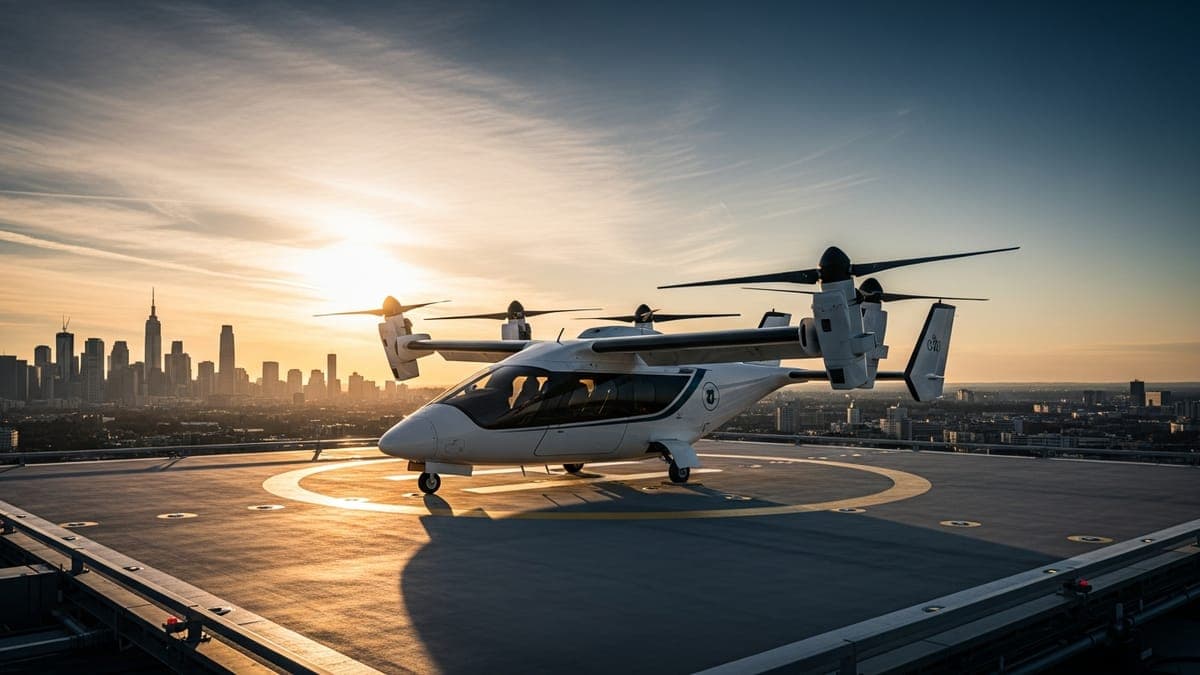
eVTOL News July 2026: Joby's Toyota JV and Virgin Atlantic Deal, Vertical Slips to 2029, and the World Cup Verdict
July 2026 was the month the eVTOL industry's post-type-certificate era took shape. Joby — fresh off its June FAA type certificate — formed a manufacturing joint venture with Toyota and signed an exclusive UK partnership with Virgin Atlantic covering London and Manchester. Vertical Aerospace pushed VX4 certification from 2028 to 2029. BETA flew the first organ-transport relay under the FAA's eVTOL Integration Pilot Program. And the World Cup closed with the verdict we projected in April: zero commercial eVTOL flights in all 16 host cities. Here's the full roundup.

DW News on eVTOLs: What They Got Right (and the Two Corrections Worth Making)
DW News dropped a tight 2026 eVTOL explainer covering AutoFlight's 10-passenger Matrix, Joby's Dubai 2026 launch, Archer's LA 2028 Olympics deal, and Vertical Aerospace's VX4. The headline timing — 3 years for something more viable, 5–10 years for full-scale rollout — is broadly right. Two factual points are worth correcting for travelers: AutoFlight Matrix is a prototype with no published Chinese type-cert pathway yet, and commercial passenger eVTOL service actually exists today in Guangzhou and Shenzhen on EHang's EH216-S. Here's the line-by-line read.
Ready to explore the future of air travel?
Discover how eVTOL technology is revolutionizing urban mobility and plan your own aerial journey.